Why does an IS auditor have the right to examine systems, and what rules govern that work? CISA Domain 1, section 1.1 answers this through ISACA's standards and guidelines, the Code of Professional Ethics, ITAF, and the audit charter. Watch the full lesson above, or read the notes below.
Short version: IS Audit Standards, ITAF and the Code of Ethics
1.1.1 ISACA audit standards
Think of three levels of authority:
| Level | What it is | Example |
|---|---|---|
| Standards | A professional requirement the auditor must meet | The conclusion must be supported by evidence |
| Guidelines | Ways to apply that requirement, using judgement | Which evidence technique fits here? |
| Tools and techniques | A practical method | A sampling worksheet, a data analysis script, an interview checklist |
Standards are mandatory. Follow the applicable requirements, and disclose any relevant departures or limitations. Guidelines help you apply the standards: you use judgement to adapt them, and explain significant departures where required.
A useful tool never excuses missing a requirement: completing a checklist does not, by itself, show the evidence is sufficient.
Three groups of requirements
- General: the auditor. Competence, independence, objectivity and due care.
- Performance: the work. Planning, supervision, materiality and evidence.
- Reporting: communicating the supported conclusion, and following up.
Reasonable assurance is a high level of confidence, supported by appropriate work. It is never a promise that every error will be found.
1.1.2 Audit guidelines
Guidelines support your judgement about how to meet a requirement in a particular engagement, but never replace it. For example, guidance on evidence helps you choose collection techniques that fit the audit objective.
1.1.3 ISACA Code of Professional Ethics
The code has seven duties:
- Support governance: encourage sound standards, governance and controls.
- Work objectively and carefully: with diligence and impartial judgement.
- Serve stakeholders lawfully: with reputable conduct.
- Protect confidentiality: never use privileged knowledge for personal gain.
- Maintain competence: accept only work you can perform with the right skills, and keep learning.
- Disclose significant facts: including facts that undermine a preferred conclusion.
- Support professional education: help stakeholders understand governance, security and risk.
1.1.4 ITAF
ITAF, ISACA's IT Audit Framework, brings together the standards, the supporting guidelines, and tools and techniques. In the established numbering:
| Category | Standards | Guidelines |
|---|---|---|
| General | 1000 series | 2000 series |
| Performance | 1200 series | 2200 series |
| Reporting | 1400 series | 2400 series |
For the exam, know the category and its authority rather than the numbers. A tool or technique never overrides a standard.
1.1.5 Independence and the audit charter
| Independence | Objectivity |
|---|---|
| The audit function's freedom to perform and communicate its work | The individual auditor's ability to judge impartially |
| No improper interference | Can fail even with a good reporting line |
A function can report to the board and still have an objectivity problem if an auditor reviews a process they recently operated.
Reporting lines: functional access to the board or audit committee supports independence. Administrative reporting must never restrict scope, access or communication.
The audit charter
The board or audit committee approves the audit charter. It sets out:
- the function's mandate: purpose, authority and responsibility
- its reporting relationships
- its right of access to records, systems and people
The charter is not recreated for each engagement.
Memory aid: CPP. The Charter gives authority. The Plan gives coverage over a period. The Program gives the procedures for one engagement. A manager's request may trigger an audit, but it never replaces the established mandate.
Who approves what?
| Item | Who |
|---|---|
| Audit charter | Board or an authorised audit committee |
| Risk-based audit plan | Prepared by the chief audit executive (CAE), discussed with senior management, approved as the charter requires |
| Audit program | CAE or a delegated audit supervisor, never the auditee |
| Working papers | Reviewed by the audit supervisor |
| Draft findings | Management validates the facts and responds; audit keeps its own judgement |
| Final report | CAE or a suitable delegate |
| Remediation and risk acceptance | Accountable management |
Read the approval verb carefully. Preparing a document is not approving it. Receiving a report is not approving its opinion. Validating a finding means checking that its facts are accurate; it does not give management the right to suppress an accurate conclusion.
Example: if a process owner shows an account was actually disabled before the deadline, verify the evidence and correct the finding. If the owner simply dislikes the finding and asks you to delete the test, audit leadership should protect the work and address the interference.
Beyond the audit team
- Security policies are approved by appropriate senior management or the governing authority.
- Business continuity is a business responsibility led by senior management, with IT responsible for recovery.
- The auditor assesses ownership and control, but never takes over the owner's approval role.
Using experts
When you use a specialist:
- Evaluate their competence, independence, scope and methods.
- Review their evidence, significant assumptions, findings and scope limitations before using the conclusion.
- Stay accountable: audit still owns the conclusion.
Outsourcing audit work
- Check first: legal restrictions, the charter, independence, competence, liability and access rights.
- Agree terms: objective, scope, period, methodology, confidentiality and access to working papers.
- Supervise: agree who reviews the work, and keep monitoring independence.
A contract can allocate responsibilities, but not audit's professional accountability.
1.1.6 Auditor perspective
The rule behind most questions:
| Management | Auditor |
|---|---|
| Owns the controls | Owns the supported assessment |
| Owns corrective action | Communicates it within the audit mandate |
If an auditor helped operate a control, disclose the objectivity concern and use an appropriate reassignment or safeguard. Being familiar with the system does not remove the impairment.
Exam traps
- Treating the engagement scope or a management request as audit's authority. The charter is the source of authority.
- Letting the auditee approve the audit program. Audit management approves it; the auditee may only comment.
- Treating ITAF guidelines as mandatory. Only standards are mandatory.
- What comes first? When establishing the audit function, the charter comes first. If the charter already exists, move on: risk assessment, then the audit plan.
Practice questions
1. A new IS audit manager finds business units disputing the audit team's right to access production systems and records. Which document is the PRIMARY source of that right?
A) The annual IS audit plan approved by the audit committee B) The engagement memo issued for each individual audit C) The information security policy approved by the CISO D) The IS audit charter endorsed by the audit committee
Answer: D. The plan sets coverage without granting access, the memo works under the charter's authority, and the security policy is a management document.
2. An IS auditor is assigned to audit the change management process she helped redesign as an internal consultant eight months ago. What should she do FIRST?
A) Disclose the potential impairment to audit management B) Limit testing to controls she did not help to design C) Ask a peer to review her completed work papers D) Decline the assignment and ask to be reassigned
Answer: A. Limiting testing and peer review are safeguards chosen only after disclosure, and reassignment is audit management's decision once they know.
3. An IS audit function engages an external specialist to test a cloud platform's security configuration. Who retains PRIMARY responsibility for the audit conclusion?
A) The external specialist who performed the testing B) The cloud provider that operates the platform C) The IS audit function that issues the report D) The audit committee that approved the audit plan
Answer: C. The specialist performs the work, but audit reviews it and owns the conclusion. The cloud provider is being audited, and the audit committee oversees audit without owning engagement conclusions.
Keep going
-
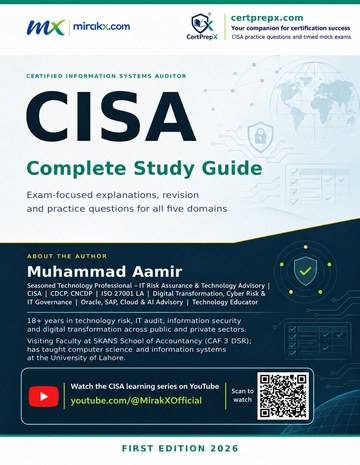
Read the free companion book, the CISA Complete Study Guide (First Edition 2026) by Muhammad Aamir. Next up is section 1.2: types of audits, assessments and reviews.
-
Watch the full CISA Complete Course by Mirak X
- Subscribe to Mirak X. New lesson every day at 6 PM (PKT)
- Free CISA practice questions and mock exams at https://certprepx.com/
Free study material. Not affiliated with or endorsed by ISACA. CISA is a registered trademark of ISACA.