Audit, assessment, review, SOC 2, Type 1, Type 2: on the CISA exam these similar words promise very different things. These notes cover CISA Domain 1, Section 1.2: how much assurance each engagement gives, how to read a SOC report, control self-assessment and integrated auditing. Watch the full lesson above, or read the notes below.
Audits, assessments and reviews
- Audit: evaluates evidence against stated criteria to support an objective conclusion.
- Assessment: evaluates a condition or capability, often to find gaps.
- Review: a general look at documents or, under a formal assurance framework, an engagement with a defined level of assurance.
Always establish the terms before you interpret the result.
| Audit type | What it looks at |
|---|---|
| IS audit | Systems protected, reliable, efficient and well controlled |
| Compliance | Laws, contracts, policies or standards |
| Financial | Fairly presented financial reporting |
| Operational | A process's controls and performance |
| Integrated | Financial, operational and IT risks together |
| Comprehensive | Record accuracy plus internal controls |
| Administrative | Administrative arrangements and efficiency |
| Specialized | One subject, service or risk area |
| Functional | Delivered software meets approved requirements |
| Third-party service | Controls at an outsourced provider |
| Fraud / forensic | Suspected irregularities, evidence fit for legal proceedings |
| Readiness | Gaps to fix before a formal audit; design, not operation over time |
Levels of assurance
Assurance is the confidence a user gets from an objective evaluation against suitable criteria. More persuasive work supports higher assurance, but it is never an absolute guarantee.
An attestation engagement reports on subject matter against suitable criteria, in three forms:
| Form | Assurance | Output |
|---|---|---|
| Examination | Reasonable (high) | An opinion |
| Formal review | Limited | A conclusion |
| Agreed-upon procedures (AUP) | None | Factual results only |
An AUP report might say 8 of 50 records lacked a required signature, with no opinion; users judge the result.
SOC reports
Outsourcing moves an activity to a provider, but the customer keeps responsibility for its own risk, and a provider's claim of strong controls is just a management assertion. SOC (System and Organization Controls) reports from the AICPA fill that gap.
- Service organization: the provider.
- User entity: the customer.
- Service auditor: an external CPA who examines the specified controls.
A SOC report saves every customer repeating the same examination, but it gives evidence only within its stated boundaries and never transfers the customer's responsibility.
| Report | Covers | Detail |
|---|---|---|
| SOC 1 | Controls relevant to customers' financial reporting (ICFR) | Used by customers and their financial auditors |
| SOC 2 | Trust Services Criteria | Detailed |
| SOC 3 | Trust Services Criteria | Less detail, can be shared publicly |
For payroll, SOC 1 means authorized pay changes, payroll calculations and processing totals. Check the scope: a SOC 1 doesn't automatically cover every process or service the provider sells.
SOC 2 uses five Trust Services Criteria categories: security (the foundation of every SOC 2), availability, processing integrity, confidentiality and privacy. Security is always included; the others only if in scope, so never assume all five.
SOC 2 is not a higher grade of SOC 1. SOC 1 asks whether customers can rely on the controls for their financial statements; SOC 2 asks whether the service is secure, available and confidential.
SOC 3 suits an initial supplier discussion, but lacks detailed controls and test results, so the full SOC 2 may still be needed.
Type 1 vs Type 2
The numbers in SOC 1 and SOC 2 mean something completely different from Type 1 and Type 2.
| Type 1 | Type 2 | |
|---|---|---|
| Time basis | A specified date | A specified period |
| Covers | Suitability of control design | Design plus operating effectiveness |
| Tests and results | Not included | Included |
A Type 1 dated 30 September is about that date. A Type 2 covering 1 July to 30 September covers that period. Neither tells you anything about October.
Reading a SOC report
Start with your own audit objective, then check:
- Service: does it cover the service, system and location you use?
- Objectives: financial reporting or trust criteria?
- Type and dates: a date or a period?
- Opinion: any qualifications? They decide how much reliance is appropriate.
- Exceptions: do they affect your risks?
- CUECs: the complementary user entity controls the customer must run.
- Subservice organizations: carve-out or inclusive?
- Gaps: close them with follow-up evidence.
A subservice organization is another provider the service organization uses, such as a data center. Under the carve-out method its controls are excluded, which can leave an evidence gap. Under the inclusive method its stated controls are included and tested.
Worked example. A payroll SOC 1 Type 2 covers January to June and assumes the customer authorizes pay changes; your audit runs to September. Inspect the opinion and exceptions, test the customer's authorization controls, and get evidence for July to September. The report can't stretch its own period.
A bridge letter is management's update after the report period, not a new examination or a replacement for missing evidence.
1.2.1 Control self-assessment
Control self-assessment (CSA) is a structured exercise in which process owners and staff identify their own risks and evaluate their own controls, through workshops, surveys, questionnaires and peer discussion. It builds understanding and ownership and spots weaknesses early. It complements audit; it never replaces it.
The limits: participants may lack assessment skills or underrate their own weaknesses, and poor facilitation can suppress disagreement. Measure better control outcomes, not the number of workshops.
| The auditor must not | The auditor may |
|---|---|
| Own the control ratings | Facilitate workshops |
| Approve action plans | Explain risk and control principles |
| Accept risk | Challenge unsupported conclusions |
Crossing that line would compromise independence. Management makes the control decisions, and audit corroborates CSA results before relying on them.
1.2.2 Integrated auditing
An integrated audit brings the financial, operational and IS auditors together around one business process, connected to the same risks and key controls instead of separate checklists. For an online order process, follow the order through pricing, inventory, dispatch, billing and accounting: agree the risks, identify key controls, test the supporting IT and management controls, and give one coordinated conclusion.
A programmed price check is only as dependable as the controls over program changes and privileged overrides.
Exam traps
- Treating SOC 2 as a better SOC 1. They answer different questions.
- Using a Type 1 as proof controls worked all year. It shows design at a date.
- Treating a bridge letter or public SOC 3 as a substitute for detailed, objective evidence.
- Letting CSA replace audit testing. It informs the audit only.
Practice questions
1. An organization is introducing control self-assessment workshops for its IT operations teams. Which role is MOST appropriate for the IS auditor in this program?
- A) Owner of the control ratings the workshops produce
- B) Approver of the action plans that teams agree upon
- C) Facilitator who guides and supports the workshops
- D) Reviewer whose sign-off replaces the annual audit
Answer: C. Owning the ratings would impair independence, and approving action plans is management's job. CSA supplements audit coverage; a sign-off can never replace the annual audit.
2. A payroll provider's SOC 1 Type 2 report covers January to June. The IS auditor's review period runs from January to September. Which approach BEST addresses July to September?
- A) Extend reliance on the Type 2 opinion through September
- B) Obtain additional evidence covering July to September
- C) Accept the provider's bridge letter as sufficient evidence
- D) Request the provider's public SOC 3 report for the year
Answer: B. A Type 2 opinion covers only its stated period. A bridge letter is management's own update, and a SOC 3 addresses trust criteria with little detail, not the financial reporting question.
3. A company evaluating a cloud document service needs assurance that access to its confidential files is protected throughout the year. Which report BEST meets this need?
- A) A SOC 1 Type 2 report on the provider's processing controls
- B) A SOC 2 Type 1 report covering security and confidentiality
- C) A SOC 3 report published on the provider's website
- D) A SOC 2 Type 2 report covering security and confidentiality
Answer: D. A SOC 1 addresses financial reporting, a Type 1 shows design at a single date, and a SOC 3 lacks the detailed controls and test results you need.
Keep going
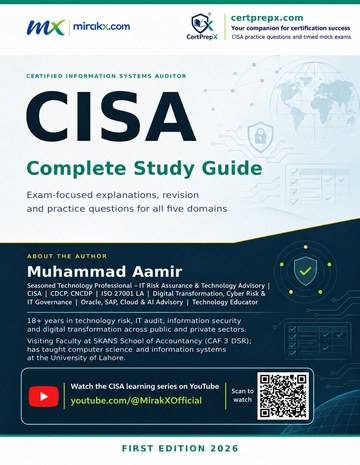
- Read the free companion book, the CISA Complete Study Guide (First Edition 2026) by Muhammad Aamir.
- Watch the full course: CISA Complete Course by Mirak X
- Subscribe to Mirak X. New lesson every day at 6 PM (PKT).
- Free CISA practice questions and mock exams: https://certprepx.com/
Free study material. Not affiliated with or endorsed by ISACA. CISA is a registered trademark of ISACA.