No audit team can test everything. So how does an IS auditor decide where to look, and how hard to test? These notes cover CISA Domain 1, Section 1.3: the audit risk model, what makes something material, and how risk assessment sets audit priorities. Watch the full lesson above, or read the notes below.
1.3.1 Selecting audit coverage
Risk-based audit planning allocates audit attention according to the organisation's relevant risks and obligations. Effort goes where the risk is, not where testing is easy or familiar.
| Level | What it does |
|---|---|
| Audit universe | The inventory of activities, processes, systems or entities that could be audited. |
| Annual plan | Selects the work for a period |
| Engagement plan | Turns one selected area into specific objectives, scope, criteria, procedures and resources |
When selecting coverage, consider:
- Business objectives and dependencies
- Recent change: new systems, processes or providers
- Prior findings
- Mandatory work and other sources of assurance
Exam tip: last year's plan is an input, never a substitute for a fresh risk assessment. Update both plans whenever significant risks change.
1.3.2 Laws and regulations
- Identify the applicable legal, regulatory and contractual requirements early, and involve specialists where interpretation is needed.
- A legal obligation can't be waived just because management accepts the risk.
- Noncompliance with no monetary loss is not automatically immaterial. Investigate its significance.
1.3.3 Audit risk and materiality
One of the most tested ideas in Domain 1. First, separate two risks:
| Business risk | Audit risk |
|---|---|
| Uncertainty affecting the organisation's objectives | The risk that the auditor reaches an inappropriate conclusion |
| Owned by management | The auditor's concern |
The audit risk model
The conceptual model is audit risk = inherent risk × control risk × detection risk.
- Inherent risk: the exposure before any safeguards.
- Control risk: the chance that controls fail to prevent or detect a material problem.
- Detection risk: the chance that the audit procedures miss it.
The key point: the auditor can't directly change the business's inherent or control risk. Detection risk is the only part you manage, through the nature, timing and extent of your procedures.
When inherent and control risk are high, you need lower detection risk and more persuasive work:
- Nature: more persuasive procedures, for example more substantive testing.
- Timing: when the work is done.
- Extent: for example, larger samples.
Detection risk has two causes: sampling risk (the sample misses a pattern) and nonsampling risk (the auditor misreads a report or uses the wrong test). They are categories, not percentages to add up.
Example: supplier payments
| Risk | In the payment process |
|---|---|
| Inherent | The process is exposed to fraud before any controls |
| Control | Bank detail changes need verification, but staff may omit the check |
| Detection | A poorly chosen audit test misses the omissions |
| Residual | The exposure remaining after the implemented controls |
Don't confuse residual risk with audit risk: residual risk is the business's exposure after controls, and management, not audit, decides how to treat it.
Four risk responses
Management chooses the response:
- Mitigate: reduce likelihood or impact with controls, such as checks on supplier bank changes.
- Avoid: stop the activity, for example withdraw an unsupported service.
- Transfer or share: insurance or contracts, though accountability doesn't disappear.
- Accept: an authorised, documented decision to retain the exposure.
Risk appetite vs risk tolerance
| Risk appetite | Risk tolerance |
|---|---|
| The broad amount and type of risk the organisation is willing to take | The acceptable variation for a particular objective or exposure |
| Strategic boundaries | For example, a defined limit for one process |
Materiality
Materiality is about what would significantly affect users of the audit conclusion. It can involve money, critical services, legal obligations or reputation. A regulatory breach, an outage of a critical service or exposed sensitive data can be material even with a tiny accounting amount.
If management accepts risk beyond its authority or above acceptable limits, audit escalates. The auditor never becomes the risk owner.
1.3.4 Risk assessment
Risk scoring combines defined factors: business criticality, financial exposure, technical complexity and change, previous findings and how controls have performed.
| Weighted score | Qualitative judgement |
|---|---|
| Some factors get more influence | Uses business knowledge and documented reasoning |
Neither becomes objective because a spreadsheet produces a number. Use consistent criteria, challenge management's estimates, and explain significant overrides.
To keep the plan honest:
- Reassess at least annually, and whenever significant change occurs.
- If resources can't cover the important risks, show the governing body the coverage gap and the exposure.
- Never quietly label uncovered risks as low.
- Management owns its business risk assessment; audit performs its own assessment to plan its work.
A risk assessment guides testing, but by itself it is never evidence that controls are effective.
1.3.5 Risk assessment techniques
Techniques include structured scoring, judgement informed by interviews and prior findings, or a mix of both. Whatever you use:
- Define the risk factors.
- Obtain reliable information.
- Document the rationale.
- Challenge the result.
A number supports judgement; it doesn't make an incomplete assessment objective.
1.3.6 Risk analysis
- Business objective: what matters.
- Threat: a potential cause of harm.
- Vulnerability: a weakness through which harm could occur.
- Risk: likelihood and consequences, with an understanding of existing controls.
A supplier master file is tiny in storage, but one unauthorised bank detail change can divert substantial funds. Business use and exposure make it important, not hardware size or transaction count.
| Qualitative | Quantitative |
|---|---|
| Descriptions such as high, medium and low | Numerical estimates, often financial amounts |
Both depend on assumptions, so record the basis.
A payroll platform with weak privileged access and significant recent change deserves more attention than a stable, well controlled system of similar size. Test the specific exposure; don't assign effort by transaction volume alone.
1.3.7 The auditor's perspective
When a question asks what to do first in planning, the answer is usually to understand what can go wrong in the business process and which criteria apply. A convenient tool or last year's audit program is not the basis for current coverage, and a material change can trigger reassessment before the annual refresh.
Exam traps
- The auditor reducing control risk. You can't; you manage detection risk.
- Accepting higher detection risk when controls are weak. It must go down, not up.
- Judging materiality by money alone. Legal, service and reputation impacts count too.
- Thinking management can accept away a legal obligation. It can't.
Practice questions
1. An IS audit manager is preparing next year's audit plan for a company that has just migrated its core finance applications to a cloud provider. What should the manager do FIRST?
- A) Estimate audit hours available for cloud-related work
- B) Perform a risk assessment of the IT audit universe
- C) Obtain the provider's latest SOC 2 Type 2 report
- D) Draft audit programs for the migrated applications
Answer: B. Estimating hours comes after the risk assessment shows where coverage is needed. The SOC 2 report is evidence gathered during engagement work, and audit programs are written once the risk-based plan is set.
2. During planning, an IS auditor concludes that inherent risk and control risk for a payments interface are both high. Which response is MOST appropriate?
- A) Lower detection risk by expanding substantive tests
- B) Accept higher detection risk since controls are weak
- C) Reduce control risk by recommending added controls
- D) Rely more on management's control self-assessment
Answer: A. Detection risk must move down, not up, when the other risks are high. Recommending controls doesn't change control risk for the current period, and management's self-assessment is less objective evidence, so it would increase detection risk.
3. An IS auditor finds a weakness in a system that processes low-value transactions but stores customer data subject to privacy law. In judging materiality, the auditor should give the GREATEST weight to:
- A) the monetary value of transactions the system processes
- B) the number of users who have access to the system
- C) the cost of implementing a compensating control
- D) the business impact if the weakness is exploited
Answer: D. Low transaction value understates the exposure when regulated personal data is at stake. User count is only an input to impact, and control cost shapes the response, not how significant the weakness is.
Keep going
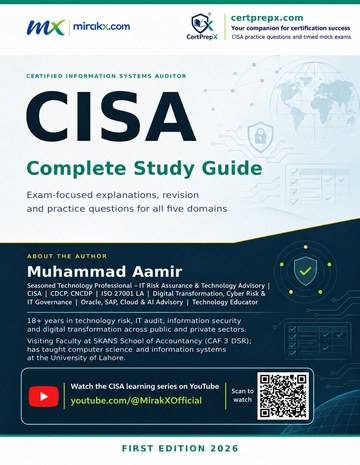
- Read the free companion book, the CISA Complete Study Guide (First Edition 2026) by Muhammad Aamir.
- Watch the full course: CISA Complete Course by Mirak X
- Subscribe to Mirak X. New lesson every day at 6 PM (PKT).
- Free CISA practice questions and mock exams: https://certprepx.com/
Free study material. Not affiliated with or endorsed by ISACA. CISA is a registered trademark of ISACA.