Who approves the audit program? What do you do when you spot a fraud red flag? And how do you stop an audit from growing out of control? This lesson covers CISA Domain 1, Section 1.5: how an IS audit engagement is planned, run, documented and kept under control. Watch the full lesson above, or read the notes below.
1.5.1 Audit objectives
Four elements must line up with each other:
| Element | What it is |
|---|---|
| Objective | The question the engagement must answer |
| Scope | The boundaries: systems, locations, activities and period covered |
| Criteria | The requirements you judge against: a policy, contract, law or standard |
| Audit program | The procedures you will run |
These must agree. A test outside the period can't support a conclusion about that period.
Example: supplier bank changes
- Objective: were supplier bank changes authorised before use?
- Scope: changes in the purchasing system from January to March.
- Criteria: the approved verification procedure for bank changes.
- Program: get the complete population of changes, select items, inspect the verification evidence and dates, investigate exceptions, and evaluate the results.
Protecting the audit's freedom to act
Agree practical arrangements with management, but never let the auditee improperly restrict necessary work. Take access restrictions to audit leadership, look for alternatives, and assess the effect on your conclusion. Significant scope changes need authorised review and documentation.
1.5.2 Audit phases
There are eight phases in an engagement:
| # | Phase | What happens |
|---|---|---|
| 1 | Understand | Objectives, process flow, owners, systems and recent change |
| 2 | Assess | The relevant risks and existing controls |
| 3 | Define | Engagement objectives, scope, criteria and resources |
| 4 | Arrange | Contacts, timing and access; deal with any restrictions |
| 5 | Program | Document and approve the procedures |
| 6 | Test and evaluate | Execute the work, validate evidence, investigate exceptions |
| 7 | Communicate | Validate facts, obtain responses, complete review, issue the supported conclusion |
| 8 | Follow up | Verify the agreed action, or escalate unresolved exposure |
Governance level vs engagement level
| Set at governance level | Needed for every engagement |
|---|---|
| The audit charter (not recreated each time) | Its own understanding of the area |
| The annual plan | Its own risk assessment and scope |
An approved plan never removes the need to understand an area before testing it.
Opening and closing meetings
Communication runs throughout, and significant issues can be raised before fieldwork ends. The opening meeting confirms arrangements. The closing meeting validates findings and management responses. Neither meeting transfers responsibility for the opinion to the auditee.
Executing the fieldwork
- Walkthroughs show how the process really runs.
- Design: evaluate whether the controls could work.
- Operation: test whether they did work, using the relevant data, and investigate every exception.
- Record: working papers link each objective to its procedures, evidence, results and conclusion, with who prepared and reviewed the work, and when.
For example, to test leaver access, identify HR departures in the period, confirm the population is complete, compare termination and disable timestamps, and investigate exceptions. A list of current users alone can't show timely removal throughout the period.
Scope creep vs managed new risk
Scope creep is unmanaged expansion beyond the agreed objectives. Say a purchasing audit finds a suspected privileged access issue across several applications.
| Scope creep | Managed new risk |
|---|---|
| Silently expanding every test | Assess the issue's link to the current objective |
| Loses control of the audit | Communicate the risk, then expand with audit approval or start a separate engagement |
Never dismiss a new issue without assessment.
Monitoring the project
Track completed work against objectives, milestones, time and budget. Raise delays, missing evidence and new risks early. Finishing on schedule never justifies removing necessary coverage without assessing the limitation.
1.5.3 Audit programs
Building a program needs business knowledge, an understanding of the technology and its risks, and the skill to choose suitable tests. Use narratives and flowcharts to find control points. Each procedure then states:
- The evidence source
- The population and selection
- The expected result
- How exceptions are treated
Another competent auditor should be able to perform it without guessing.
Send an advance evidence request with responsible contacts, due dates and a secure collection method. Monitor progress against budget, and escalate evidence delays and skill gaps early.
1.5.4 Audit working papers
Working papers show how the objective was addressed and why the conclusion is justified. A usable test record identifies:
- The objective, source population and selection method
- The procedure and expected result
- The evidence reference, actual results and exceptions
- The conclusion, plus the preparer and the reviewer
No unexplained ticks or mystery screenshots. Protect and retain working papers as required.
1.5.5 Fraud, irregularities and illegal acts
| Fraud | Error |
|---|---|
| Involves intentional deception | Can happen without intent |
An irregularity, or red flag, is a reason to investigate, not proof of fraud.
Management is responsible for controls that deter and detect misconduct. When the auditor sees a red flag, the auditor:
- Stays alert to unusual patterns, collusion and management override.
- Preserves the evidence.
- Reports through the authorised route.
- Involves qualified investigators and legal advisers.
Avoid accusations, or anything that could compromise an investigation.
1.5.6 Agile auditing
Agile auditing uses a prioritised backlog and short sprints to deliver usable results sooner.
- Overlap: planning and fieldwork can run in parallel. One auditor validates an extract while another plans a different process.
- Ceremonies: short coordination meetings reveal blockers, a sprint review discusses completed work, and a retrospective improves the method.
- Benefits: faster feedback, less idle time and closer communication with stakeholders.
The definition of done still includes enough evidence, documentation, review and a supported conclusion. Scope changes still need approval, and audit leadership keeps control of audit judgements and coverage. Agile changes the sequence of work, not the standard.
Exam traps
- Letting the auditee approve the audit program. The auditee comments; audit management approves.
- Investigating fraud indicators alone, such as interviewing the suspect. Escalate first.
- Changing scope silently, in either direction. Assess, approve and document.
- Thinking Agile means less evidence. It doesn't.
Practice questions
Question 1. The IS audit team has drafted the audit program for a review of the treasury system. The treasury manager asks to approve the test steps before fieldwork starts. Which response is MOST appropriate?
A) Seek audit management approval and weigh the manager's comments B) Let the treasury manager approve the program as the system owner C) Submit the program to the audit committee for formal approval D) Begin fieldwork and share the program at the closing meeting
Answer: A. Auditee approval of test steps would compromise audit independence. The audit committee approves the charter and the risk-based plan, not individual programs, and withholding the program until closing undermines cooperation and planning.
Question 2. During fieldwork, an IS auditor notices vendor master file changes made by an accounts payable clerk outside business hours, followed by payments to those vendors. The auditor has preserved the relevant logs. What should the auditor do NEXT?
A) Interview the clerk to obtain an explanation of the changes B) Report the indicators to audit management for escalation C) Expand sampling to quantify total losses before reporting D) Recommend the clerk's system access be suspended at once
Answer: B. Questioning the suspect early may alert them and compromise a formal investigation. Delaying the report to quantify losses increases exposure, and access decisions belong to management through the proper escalation channel.
Question 3. During a purchasing audit, an IS auditor discovers a suspected privileged access weakness that also affects several other applications. What should the auditor do FIRST?
A) Expand all current tests to cover the other applications B) Note the issue for next year's plan and continue the audit C) Assess its link to the objective and communicate the risk D) Ask IT to fix the privileged access before testing continues
Answer: C. Expanding every test without assessment is unmanaged scope creep, and parking it for next year ignores a significant current risk. Fixing it is management's decision; the auditor communicates the risk.
Keep going
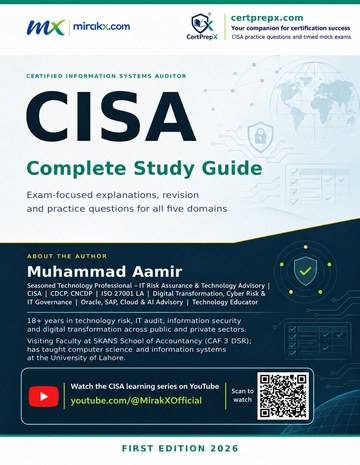
- Read the free companion book, the CISA Complete Study Guide (First Edition 2026) by Muhammad Aamir.
- Watch the full CISA Complete Course by Mirak X. Next up is Section 1.6, Audit Testing and Sampling Methodology.
- Subscribe to Mirak X on YouTube. New lesson every day at 6 PM (PKT).
- Try free CISA practice questions and mock exams at https://certprepx.com/.
Free study material. Not affiliated with or endorsed by ISACA. CISA is a registered trademark of ISACA.