You test every record in the population and find no exceptions. Is the control clean? Not if the extract was incomplete or the join was wrong. This lesson covers CISA Domain 1, Section 1.8: how data analytics, CAATs and continuous auditing produce reliable audit evidence, and how to use AI without trusting it blindly.
1.8 Audit data analytics
Audit data analytics uses defined tests of data to answer an audit question. Define the objective, verify the data and test the analysis logic before interpreting the results. Plan the analysis before choosing a tool.
| Analysis | Example |
|---|---|
| Matching and reconciliation | Compare HR departures with system accounts; investigate unmatched records |
| Duplicate and gap detection | Repeated invoice identifiers or missing sequence numbers |
| Recalculation | Recompute interest, tax or payroll using approved rules |
| Trend and outlier analysis | Unusual changes, times, values or activity; an outlier needs investigation |
| Stratification and selection | Separate high-value items or extract items meeting risk criteria |
Validate the data and the analysis
- Reconcile extracted counts and relevant totals to independent source information.
- Check joins, filters, missing identifiers, duplicates, time periods and field meanings.
- Test the query or script with known cases, and preserve the query, parameters, field definitions and script version.
A join on employee name misses accounts whose names have changed. Use a reliable identifier and investigate unmapped accounts.
Whole population testing can remove sampling risk for that test. It does not remove incomplete data, faulty logic or other nonsampling risks. The auditor should control or independently validate extraction; an auditee-assisted extraction can be usable when the method and completeness are verified.
1.8.1 Computer-assisted audit techniques
Generalized audit software (GAS) supports reading files, sorting and joining, filtering, sampling, statistical analysis, recalculation and reporting.
| Technique | Data and processing | What it shows |
|---|---|---|
| Test data | Known test transactions run through the application | Whether application rules handle known cases correctly |
| Parallel simulation | Independent audit logic reprocesses actual records | Differences from the application's results |
| ITF | Dummy entity in controlled production processing | How the live application processes test cases |
| Tracing and tagging | Selected real transactions are tagged and followed | The processing path, without a dummy entity |
A test deck should include normal, boundary and invalid cases: below, at and above a credit limit, plus an invalid customer ID. Black box testing checks behavior against expected results without knowledge of the code; white box testing uses the code structure to select tests.
Protect production: request read-only access, work on controlled copies, and make sure tests cannot distort genuine business records.
Source code comparison compares like with like: source with approved source, executable with approved executable. An unchanged executable does not prove its configuration or data is appropriate.
1.8.2 Continuous auditing and monitoring
- Continuous auditing: recurring or automated audit procedures; audit independently evaluates evidence, coverage and response.
- Continuous monitoring: management's ongoing assessment of its own processes and controls; management acts on the alerts.
1.8.3 Continuous auditing techniques
| Technique | How it works |
|---|---|
| EAM and SCARF | Embedded audit module captures selected transactions into a systems control audit review file |
| Snapshot | Records selected information at stages along a transaction's path |
| Audit hook | A specified condition triggers an alert or capture |
| ITF | Dummy entities processed in the live application; effects isolated or reversed |
| CIS | Selects transactions meeting criteria and simulates their processing |
Identify required records, audit trails and access early in system development. Audit may advise on auditability; management owns implementation.
1.8.4 Artificial intelligence in IS audit
An algorithm is a specified method. Machine learning learns patterns from data. RPA executes configured workflow steps and need not use AI. Supervised learning uses known outcomes (classification or regression); unsupervised learning finds structure without labels, such as clustering.
- A false positive flags a legitimate item; a false negative misses a real problem.
- Overfitting learns training noise and fails on new data; underfitting misses important relationships.
- Drift means performance changes as data or conditions change. Version data, models, thresholds and scripts.
Statistical significance does not establish business importance or misconduct. Generative AI can invent requirements and citations, so verify outputs against source evidence and keep human accountability. An alert is the start of an investigation, not its conclusion.
Practice questions
1. An IS auditor wants to verify interest calculated by a loan application, using actual loan records and logic the auditor controls. Which technique is MOST appropriate? A. Test data submitted through the application B. An integrated test facility with a dummy loan entity C. Snapshots along the interest posting path D. Parallel simulation reprocessing the actual loan records
Answer: D. Test data and ITF use test transactions, and snapshots do not recompute anything.
2. An IS auditor wants an alert as soon as a payment above a set threshold is processed in a live application. Which technique BEST achieves this? A. Snapshots of each payment's processing stages B. Monthly parallel simulation C. An audit hook on the defined payment condition D. An integrated test facility with dummy suppliers
Answer: C. An audit hook triggers on a specified condition; the others are not timely or do not test real payments.
Keep going
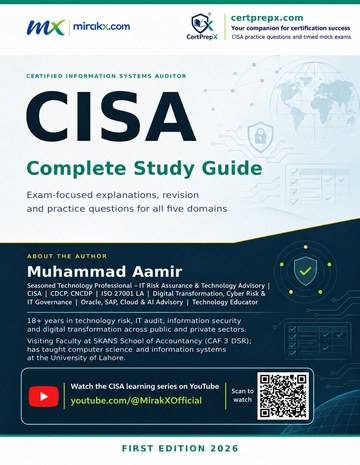
- Read the free companion book, the CISA Complete Study Guide by Muhammad Aamir.
- Watch the full CISA Complete Course by Mirak X. Next up is Section 1.9, Reporting and Communication Techniques.
- Subscribe to Mirak X on YouTube. New lesson every day at 6 PM (PKT).
- Try free CISA practice questions and mock exams at https://certprepx.com/.
Free study material. Not affiliated with or endorsed by ISACA. CISA is a registered trademark of ISACA.