A supplier's marketing says your payroll data is hosted locally. Is that enough for the audit? This lesson opens CISA Domain 2 and covers Section 2.1: how an IS auditor works out which requirements apply and then tests the enterprise against them.
Domain 2 overview
Domain 2, Governance and Management of IT, is 18 percent of the CISA exam. Technology creates value only when it supports a business purpose, has accountable owners, and runs within acceptable risk. The domain looks at how an enterprise directs IT, turns that direction into plans and services, protects its data, and checks the results.
- Part A, IT Governance: 2.1 Laws, Regulations and Industry Standards; 2.2 Organizational Structure, IT Governance and IT Strategy; 2.3 IT Policies, Standards, Procedures and Guidelines; 2.4 Enterprise Architecture; 2.5 Enterprise Risk Management; 2.6 Data Privacy Program and Principles; 2.7 Data Governance and Classification.
- Part B, IT Management: 2.8 IT Resource Management; 2.9 IT Vendor Management; 2.10 IT Performance Monitoring and Reporting; 2.11 Quality Assurance and Quality Management of IT.
The approach for the whole domain is to follow the decision and its evidence. If a retailer approves a cloud customer platform, that approval alone does not establish good governance, lawful data use, or successful delivery.
2.1.1 Impact of laws, regulations and industry standards on IS audit
Legal and regulatory obligations set the constraints the business and IT must operate within. Industry standards and contracts may add requirements. The auditor first establishes which criteria apply, then tests against them.
Applicability can depend on where customers live, where processing takes place, the industry, and the service offered. A law in one country does not automatically apply everywhere, and a voluntary standard can become binding through a contract or a regulatory requirement.
The auditor gets a current understanding of the obligations, with help from legal and compliance specialists where needed. Each relevant obligation becomes an audit criterion with an owner, controls and evidence of compliance. A policy that repeats the law is insufficient if the operational process does not meet it.
| Requirement | Meaning | Audit implication |
|---|---|---|
| Law | Legislation enacted by a competent authority | Determine applicability; examine controls and records |
| Regulation | Rules issued under legal authority by a regulator | Check sector, reporting and supervisory obligations |
| Industry standard | Agreed requirements or recognized practices | Is adoption voluntary, contractual or mandated? |
| Contract | An enforceable agreement between parties | Review service, data, licensing, assurance and termination duties |
| Internal policy | Approved enterprise direction | Evaluate conformance and coverage of external obligations |
Example: a payroll supplier hosts records outside the customer's home country. Consider the employment, privacy, transfer, contractual and retention requirements. Don't take local hosting from the supplier's marketing statement. Establish the actual data flow and jurisdictions.
Software licensing and intellectual property
A software license grants specified rights of use. Buying access does not normally transfer ownership. Restrictions can depend on users, devices, processors, deployment locations or use by contractors. Reconcile entitlements to deployment and actual use, including virtual environments and cloud services. Review renewal and termination terms, and investigate unauthorized installations. The enterprise also protects its own source code and know-how through access controls and agreements.
2.1.2 Governance, risk and compliance
GRC connects direction, uncertainty and obligations. Governance sets objectives and decision rights, risk management assesses uncertainty affecting those objectives, and compliance determines and monitors the requirements to meet. Coordinating them prevents conflicting policies, duplicated testing, and obligations falling between teams.
A shared control library can map one control to several requirements, but that does not make the requirements identical. Owners still need to understand each one's scope and evidence.
Audit focus: the obligations register, legal change process, owners, control mappings, compliance reporting and unresolved breaches. Internal audit assesses this independently. It does not become the legal adviser or accept management's risk, and it should not invent a universal legal answer from a short technical scenario.
Turning obligations into auditable requirements
A named standard in a policy does not prove its full scope has been implemented. Keep a requirements register that links each applicable duty to a process owner, control, evidence and review date. Track changes in obligations and business activity, because a once-completed compliance checklist can become stale. Gap analysis compares the implemented state with the applicable requirements, so set the criteria and scope first.
Example: moving backups to another jurisdiction. Encryption may reduce disclosure exposure, but it does not by itself make the transfer, processing location and retention permitted. Examine the arrangement, duties, contract, and access and deletion capability.
Worked example: a contract requires records to be retrievable for a stated retention period, but the latest retrieval test covered only recent records. Select older records near the retention boundary and verify that authorized users can retrieve and read them.
Practice questions
1. An enterprise's retention policy repeats the applicable law word for word. What provides the BEST evidence of compliance? Answer: testing the records kept by the operational process. Policy approval, clause mappings and attestations don't show what actually happens.
2. An industry standard is voluntary, but a customer contract requires the enterprise to follow it. How should the IS auditor treat the standard? Answer: as an applicable audit criterion. A voluntary standard can become binding through a contract.
Keep going
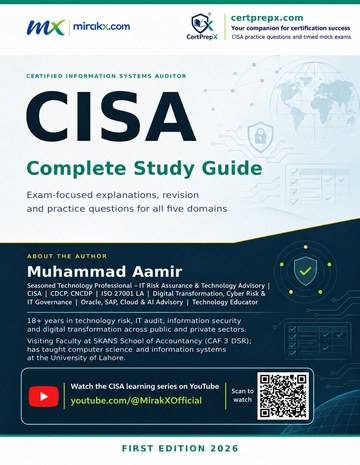
- Read the free companion book, the CISA Complete Study Guide by Muhammad Aamir.
- Watch the full CISA Complete Course by Mirak X. Next up is Section 2.2, Organizational Structure, IT Governance and IT Strategy.
- Subscribe to Mirak X on YouTube. New lesson every day at 6 PM (PKT).
- Try free CISA practice questions and mock exams at https://certprepx.com/.
Free study material. Not affiliated with or endorsed by ISACA. CISA is a registered trademark of ISACA.