The board approves a digital strategy, but a year later the money has gone to projects with no link to it. Is the strategy document enough evidence of alignment? This lesson covers CISA Domain 2, Section 2.2: who decides, whose needs the decisions serve, and how results are overseen.
2.2.1 Enterprise governance of information and technology
EGIT covers information and technology across the whole business, not just the IT department. The governing body evaluates stakeholder needs, directs priorities and monitors results, with a focus on value and exposure. Management plans and delivers within that direction. Both monitor, but for different purposes.
Governance sets direction. Management delivers and reports. Audit supplies independent assurance.
2.2.2 Good practices for EGIT
Good governance combines strategic alignment, value delivery, risk management, resource management and performance measurement. A low-cost service that blocks a critical business transaction is not a success just because it met its budget.
In COBIT, governance is EDM (Evaluate, Direct, Monitor). Management domains are APO (Align, Plan and Organize), BAI (Build, Acquire and Implement), DSS (Deliver, Service and Support) and MEA (Monitor, Evaluate and Assess).
| Reference | Primary purpose |
|---|---|
| ISO/IEC 38500 | Governance principles for governing bodies |
| ITIL / ISO/IEC 20000 | Service management practices / requirements |
| ISO/IEC 27001 | Information security management system requirements |
| NIST CSF 2.0 | Six functions: Govern, Identify, Protect, Detect, Respond, Recover |
| CMMI | Capability and process improvement, not a security certification |
Framework adoption is evidence of an approach, not proof that controls operate effectively.
2.2.3 Audit's role and the Three Lines Model
The IS auditor evaluates whether governance supports business objectives, assigns accountability, manages significant risk and enables useful oversight.
- First line: process owners deliver services and own the risk.
- Second line: risk, security oversight and compliance teams advise, monitor and challenge. They remain management roles.
- Third line: internal audit gives independent assurance to the governing body, and must not take management responsibility for what it later audits.
2.2.4 Information security governance
Security governance sets priorities, accountability, resources, policy direction and oversight. A firewall configuration is an operating control; deciding security direction and holding management accountable are governance.
2.2.5 and 2.2.6 IS strategy and strategic planning
The IS strategy explains how systems and technology enable business objectives, and business and IT build it together. Alignment shows when initiatives map to outcomes, with sponsors, benefits, resources and measures. A list of products to buy is not a strategy.
Planning assesses the current state, defines target capabilities, identifies gaps and prioritizes a roadmap. Review strategy when conditions change; a fixed five-year cycle does not justify an obsolete plan. Auditors trace major initiatives to strategy, approved cases, benefit owners and actual spending.
2.2.7 Business intelligence
A dashboard's appearance does not prove its data are complete. Metadata describes meaning, format, owner and rules. Lineage traces a figure back to authorized source transactions. When sales and finance define "active customer" differently, business owners agree the definition first.
2.2.8 Organizational structure
| Body or role | Primary responsibility |
|---|---|
| IT strategy committee | Advises the board on IT direction and value |
| IT steering committee | Prioritizes initiatives, allocates resources, monitors delivery |
| Data owner | Decides classification and authorized access |
| Data custodian | Operates technical safeguards and storage |
| Security administrator | Implements approved privileges |
Separation of duties splits authorization, execution, recording and reconciliation so one person cannot create an error and conceal it. In a RACI matrix, each activity needs one clear Accountable owner. Where a small team cannot separate roles, a compensating control must address the specific conflict, such as independent review of protected change logs against approved requests.
2.2.9 Auditing IT governance
Corroborate charters, strategy and reports with interviews and samples of real decisions. Red flags include repeated unapproved purchases, unresolved ownership, obsolete plans and projects monitored only for spending. Gap analysis compares the current state with an agreed target; management selects priorities and accepts residual risk, while audit evaluates the evidence.
Practice questions
1. An IS auditor is assessing whether IT investments support the business strategy. Which evidence would BEST demonstrate alignment? A. A board-approved IT strategy document B. Initiatives traced to objectives, sponsors and realized benefits C. Formal adoption of the COBIT framework D. Steering committee minutes showing IT attendance
Answer: B. A strategy or framework shows an approach, not that funding follows it.
2. Which party should decide whether a business user may access customer account data? A. The security administrator B. The data custodian C. The business data owner D. The IT steering committee
Answer: C. Administrators and custodians implement access under the owner's direction.
Keep going
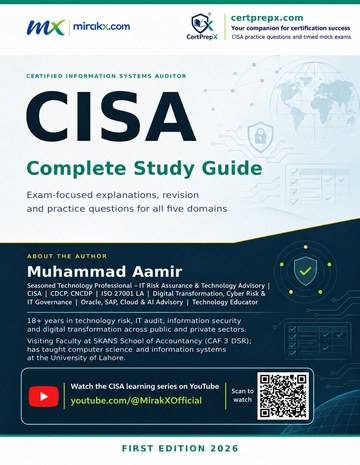
- Read the free companion book, the CISA Complete Study Guide by Muhammad Aamir.
- Watch the full CISA Complete Course by Mirak X. Next up is Section 2.3, IT Policies, Standards, Procedures and Guidelines.
- Subscribe to Mirak X on YouTube. New lesson every day at 6 PM (PKT).
- Try free CISA practice questions and mock exams at https://certprepx.com/.
Free study material. Not affiliated with or endorsed by ISACA. CISA is a registered trademark of ISACA.