Before you study a single CISA domain, it helps to understand the exam itself: what the certification is, how the exam is scored, what the five domains cover and how ISACA's questions test your judgement. This is episode 0 of the CISA Complete Course by Mirak X. Watch the full lesson above, or read the notes below.
What is CISA?
CISA stands for Certified Information Systems Auditor. It is an ISACA certification focused on auditing, controlling and protecting information systems, and on evaluating how technology supports business objectives. It is relevant to audit, assurance, risk and information security careers.
The CISA view is broader than picking a secure product and calling the job done:
| Technical view | Auditor view |
|---|---|
| Pick a secure product | Who owns the control? |
| Job done? | Does it actually operate? |
| What evidence proves it addresses the risk? |
Passing is only one part
To hold the certification you need three things:
- Pass the exam.
- Relevant professional experience, with some permitted substitutions.
- Apply within the allowed period.
Passing alone does not let you claim the designation. Check your own eligibility on the ISACA website.
Exam format and scoring
| Item | Detail |
|---|---|
| Questions | 150 multiple choice, one best answer from four |
| Time | 4 hours (240 minutes) |
| Pass mark | 450 on ISACA's 200 to 800 scale |
Pacing: 240 minutes divided by 150 questions is about 1.6 minutes per question. Practise timed, and keep time at the end to review uncertain questions.
Three scoring facts:
- It's a scaled score, not a simple percentage of correct answers.
- No penalty for wrong answers. The current candidate guide says so, so answer every question.
- A practice test percentage is useful feedback, but it does not convert directly into your official score.
Before exam day, read ISACA's current candidate guide, check the identity requirements, and follow the test centre or remote proctoring instructions carefully.
The 5 CISA domains
These are the published weights from ISACA's exam content outline:
| Domain | Weight | What it tests |
|---|---|---|
| 1. Information System Auditing Process | 18% | Scope, controls, evidence, sampling, reporting |
| 2. Governance and Management of IT | 18% | Strategy, risk, policy, privacy, vendors |
| 3. Acquisition, Development and Implementation | 12% | Business cases, projects, the development life cycle, migration |
| 4. Operations and Business Resilience | 26% | Processing, incidents, backups, continuity, disaster recovery |
| 5. Protection of Information Assets | 26% | Access control, network security, cryptography, PKI, cloud, incident response |
Domains 4 and 5 together are 52% of the exam, the biggest share. Domains 1, 2 and 3 are 48%, so none of them can safely be ignored. Plan your time by weight, then adjust for weak areas.
Why start with Domain 1?
Domain 1 gives you the audit method you use in every other domain. A security question from Domain 5 may still ask you to choose evidence or decide how to report a finding. That is Domain 1 reasoning.
Keep this audit reasoning chain in mind for every domain:
Objective → Risk → Evidence (for the right population) → Supported conclusion → Follow-up
Example: access remains after an employee leaves. Domains 2 and 5 give you the subject knowledge: ownership and the identity lifecycle. Domain 1 gives you the audit reasoning: validate the leaver list, test the timing, and report the supported finding.
How CISA questions test judgement
CISA questions test judgement, not memory. Read the whole question and identify four things:
- Actor: who is acting?
- Objective: what business result is wanted?
- Stage: what has already happened?
- Qualifier: the exact word, such as FIRST, BEST or PRIMARY.
Several options may be useful; the right one best fits the objective and the stage.
Know your qualifiers
| Qualifier | What it asks |
|---|---|
| FIRST | Which necessary action comes before the others in this situation? |
| NEXT | Given what's already complete, what follows? Don't repeat a stage that's done. |
| BEST / MOST appropriate | Which option most completely fits the objective and constraints? |
| MOST effective | Which control most directly achieves the result? |
| PRIMARY | The central purpose, not a secondary benefit. |
| GREATEST concern | The biggest exposure given the facts, not the most dramatic wording. |
A repeatable method
- Restate the question in your own words.
- Eliminate options that answer a different objective, use the wrong owner, or belong to the wrong stage.
- Compare what's left against the facts.
- Choose, and be able to say why the closest alternative is weaker.
ISACA's conventions
ISACA keys its answers to its review material's conventions, some of which simplify real practice. For example, the exam treats the business impact analysis as the first step of continuity planning. When real-world nuance and convention seem to conflict, answer with the convention, unless the question gives facts that rule it out.
How to study for CISA
Study each topic in four passes:
- Read: the explanation and an example, and define new terms.
- Recall: rebuild the idea without looking.
- Practise: answer questions and explain every option.
- Revise: weak areas, with memory aids and the glossary.
A flexible 8-week route
| Week | Focus |
|---|---|
| 1 | Domain 1, plus a diagnostic test |
| 2 | Domain 2 |
| 3 | Domain 3 |
| 4–5 | Domain 4 |
| 6–7 | Domain 5 |
| 8 | Mixed questions and timed mock exams |
This is a guide, not a rule: spend longer on your weak areas.
Keep an error log
For every question you miss, record why: a knowledge gap, role confusion, the wrong qualifier, a missed fact, or a timing problem. Then retest that idea on a fresh scenario a few days later.
Exam traps
- Adding facts to rescue a distractor. Answer from the facts given, not the ones you imagine.
- Assuming the biggest option wins. The most senior escalation, the most expensive tool or the most restrictive control is not always correct.
- A policy offered in place of real evidence, or a detective control offered where prevention is needed, on a MOST effective question.
- Repeating a completed stage on a NEXT question.
- Overriding ISACA's convention with real-world nuance when the question's facts don't require it.
Practice questions
1. During testing, an IS auditor finds an apparent approval exception but has not yet verified the record or understood the workflow. What should the auditor do FIRST?
A) Report the exception to the audit committee B) Verify the record and understand the workflow C) Record the exception as a finding in the draft report D) Increase the sample size to look for more exceptions
Answer: B. Escalating to the audit committee is premature because nothing shows evidence destruction or interference, a finding comes only after the facts are verified, and a bigger sample doesn't confirm the exception you already have. If the facts showed fraud or interference, the answer would change.
2. An IS auditor must conclude whether leavers' access was removed on time throughout the year. Which evidence is BEST?
A) The approved policy on removing leaver access B) A written assurance from the IT security manager C) A screenshot of today's disabled user accounts D) Matched HR exit dates and account disable dates
Answer: D. A validated match of HR exit dates to account disable dates covers the whole year. A policy shows intent, not that removal happened; a manager's assurance needs corroboration; and a screenshot covers a single moment. What matters is the fit between the evidence and the conclusion.
Keep going
-
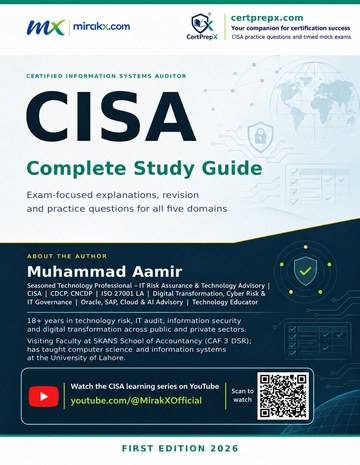
Read the free companion book, the CISA Complete Study Guide (First Edition 2026) by Muhammad Aamir. The next lesson starts Domain 1 with section 1.1: IS audit standards, guidelines and the Code of Professional Ethics.
-
Watch the full CISA Complete Course by Mirak X
- Subscribe to Mirak X. New lesson every day at 6 PM (PKT)
- Free CISA practice questions and mock exams at https://certprepx.com/
Free study material. Not affiliated with or endorsed by ISACA. CISA is a registered trademark of ISACA.